
Casinos That Accept eCheck in the UK: Payment Guide
 Available in GB
A bank transfer or electronic-payment label does not confirm eCheck support, so verify the exact route, costs and withdrawal rules.

Table of Contents
- What UK Casino Cashiers Actually Offer
- How to Check Whether a Payment Route Is Available
- Deposit Options, Limits and Account Controls
- Instant Deposits Do Not Guarantee Fast Payouts
- Keep the Payment Route in Your Own Name
- Compare Payment Costs for the Amount You Will Send
- Check Payment Compatibility Before Using a Casino App
- Confirm the Details Before You Make a Deposit
- Understand the Total Cost of a Casino Payment
- Why Casino Withdrawals May Not Return by the Same Route
What UK Casino Cashiers Actually Offer
If you are looking for casinos that accept eCheck in the UK, it helps to separate that specific payment label from the wider range of methods used by UK casino cashiers. Debit cards are a familiar option: UK casinos commonly accept Visa and Mastercard debit cards. Open banking and bank transfers are also part of the payment landscape, but their presence does not establish that a cashier offers eCheck.
That distinction matters because payment terms are not interchangeable. A cashier listing a bank transfer does not, by itself, show that it supports every way of sending money from a bank account. Nor does a general reference to electronic payments confirm that eCheck is available. The method you are trying to use needs to be identified as that method, not inferred from a neighbouring label.
The familiar options
Debit cards have a straightforward place in the UK casino payment mix. Visa and Mastercard are commonly accepted, giving players a recognisable card route for deposits. They are debit cards, not credit cards: UK-licensed casinos cannot accept credit-card payments for gambling. A card logo alone should not be read as permission to use a credit product.
If you’re looking for a UK casino that accepts echeck, check the payment options available to you before depositing. The payout times listed here can help you assess withdrawal speed, but they do not confirm echeck availability.
Payout speed: 1-3 business days x3bet lists a payout speed of 1–3 business days. Check its payment options to confirm whether echeck is available to you.
Payout speed: 1-3 business days Britsino lists a payout speed of 1–3 business days. You’ll need to check its payment options to confirm echeck availability.
Payout speed: 1-3 business days NightWin lists a payout speed of 1–3 business days. Check directly whether echeck is among the payment methods available to you.
Payout speed: 1-3 business days WinBeast lists a payout speed of 1–3 business days. Its echeck availability isn’t specified, so check the payment options before depositing.
Payout speed: 1-3 business days Dieselwin lists a payout speed of 1–3 business days. Confirm directly whether echeck is available as a payment method.
Payout speed: 1-3 business days Chanze lists a payout speed of 1–3 business days. Check its current payment options to see whether echeck is available to you.
Payout speed: 1-3 business days SlotoSport lists a payout speed of 1–3 business days. The available information doesn’t confirm echeck support, so check before depositing.
Payout speed: 1-3 business days BeOnBet lists a payout speed of 1–3 business days. Check its payment options directly to confirm whether you can use echeck.
Payout speed: 1-3 business days SpinFormula lists a payout speed of 1–3 business days. Echeck availability isn’t specified; check the payment options before you deposit.
Payout speed: 1-3 business days NightLuck lists a payout speed of 1–3 business days. Confirm directly whether echeck is available among its payment methods.
Open banking and bank transfers provide another route between a player’s bank and a casino. A specialist payment review reports that these methods can support instant deposits and fast withdrawals at many sites. That is a qualified description, not a promise about every casino or every transaction. It also does not mean that a bank transfer and eCheck are the same thing. Similar involvement of a bank does not make two payment routes interchangeable.
For comparison, the broad categories look like this:
| Payment category | What can be said about its place in the UK landscape |
|---|---|
| Debit cards | UK casinos commonly accept Visa and Mastercard debit cards. |
| Open banking | Specialist payment coverage reports instant deposits and fast withdrawals at many sites. |
| Bank transfers | Specialist payment coverage reports that they can provide instant deposits and fast withdrawals at many sites. |
| eCheck | Its availability cannot be inferred from the categories above. |
The table is a map of payment categories, not a list of methods guaranteed to appear in any particular cashier. No winner emerges without a criterion: debit cards are the familiar reference point, while open banking and bank transfers are relevant when considering bank-linked routes. Neither comparison answers whether an eCheck option is offered.
Why eCheck needs its own label
The phrase “eCheck” may lead you to expect a bank-based payment. That expectation is not enough to establish acceptance. A casino could offer debit cards or bank transfers without offering eCheck, and a broad description of a cashier as supporting electronic payments would not settle the question either. The exact method matters.
This is especially useful when comparing online casinos that appear to take bank payments. Treating every bank-connected route as equivalent can make a payment description sound more specific than it is. If your requirement is to pay with eCheck, a general list of cards, open banking or transfers does not answer it. The name of the route needs to be explicit.

There is no need to turn the broader landscape into a ranking. “Best” depends on the criterion: familiarity may point you towards debit cards, while a bank-linked route may be more relevant if you want to use open banking or a transfer. Neither criterion establishes eCheck acceptance. A ranked list would only help if its entries were verified for the particular method being compared.
The practical starting point, then, is modest: UK casino payments commonly include debit cards, and bank-linked options are also used. eCheck remains a separate question rather than a synonym for either category. That is a useful distinction.
How to Check Whether a Payment Route Is Available
A payment method mentioned on a casino page is not proof that you can use it. The cashier attached to your account is the practical check: it shows which routes the operator currently presents for your circumstances, rather than what a general description or an older listing says. If you are looking for a casino that accepts eCheck, do not treat a reference to bank payments, electronic transfers or a payment brand as confirmation that eCheck itself is available.
Do not treat a reference to bank payments, electronic transfers, or a payment brand as confirmation that eCheck itself is available.
Start by signing in and opening the cashier, then inspect the deposit methods shown there. Check the method’s exact name and any accompanying instructions. A broad label such as “bank transfer” does not identify every bank-based route, and it does not establish that a particular eCheck service is included. Nor does seeing a method described elsewhere mean it will appear for your account. Availability should be established in the transaction screen before you begin a payment.
Read the next step of the cashier flow before submitting anything. The displayed option may lead to a provider page or a bank authorisation screen, where the route and payment details become clearer. If the process does not identify the method you intended to use, pause rather than assuming that a similar-sounding option is equivalent. A successful-looking label is not a substitute for a clear route.
A search result, comparison page or general payment-method list can help you decide what to inspect, but it cannot confirm the current options in your account. A specialist review may list Visa and Mastercard, for instance, while the cashier remains the place to check whether those cards are currently available to UK customers and whether your particular card product is eligible. Treat the list as a prompt to verify, not as a live acceptance decision.
That distinction matters for cards as well as bank-based payments. UK-licensed casinos cannot accept credit-card payments for gambling, and the ban also covers credit-card funding routed through a money service business. A card logo alone does not tell you whether a specific product can be used. Check the cashier’s eligibility information and follow the route it presents; do not assume that a credit card becomes acceptable because it is connected to a wallet or another service.


The same care applies when a casino describes itself as supporting a payment brand. A brand name may cover different products or routes, and availability can depend on the account and the payment journey. If the cashier does not show the option, or its instructions do not match the method you were looking for, do not infer acceptance from a general label. Ask the operator to clarify whether that precise route is available before proceeding.
Check the account currency separately
Confirm your account currency before the first transaction. A specialist review may describe GBP support, but that does not confirm the currency selected for your individual account. Look for the currency displayed in your account or cashier and make sure it is GBP if that is what you intend to use. This is a separate check from confirming that a payment method is listed: a route can appear in the cashier while the account is set to a different currency.
If the currency shown is not clear, resolve that before entering payment details. Do not assume that a UK-facing site or a UK payment option automatically means your account is denominated in pounds. Currency settings can affect how a transaction is handled, so the useful checkpoint is the value shown for your own account, not the wording on a general information page.
- Confirm the exact payment route is offered in the cashier
- Verify the account currency is set to GBP
- Rely on broad statements that a casino supports bank payments
- Assume a UK-facing site automatically means your account is in pounds
Keep the two checks distinct. First, confirm that the exact payment route is offered to you in the cashier. Then confirm the account currency. Neither check is a comparison of speed or price, and neither can be replaced by a broad statement that a casino supports bank payments or GBP.
A practical check is deliberately unglamorous: open the cashier, identify the exact route, read its instructions, and verify the account currency before continuing. If one of those details is unclear, stop and seek clarification from the operator rather than guessing from a search listing. Clear evidence in the account flow is more useful than a confident-looking label.
Deposit Options, Limits and Account Controls
A deposit threshold is an entry condition, not a budgeting guide. The minimum tells you the smallest amount a cashier will accept through a particular route; it does not tell you what is sensible to spend. Keep those questions separate when comparing casino deposits, including any route described as an eCheck payment.
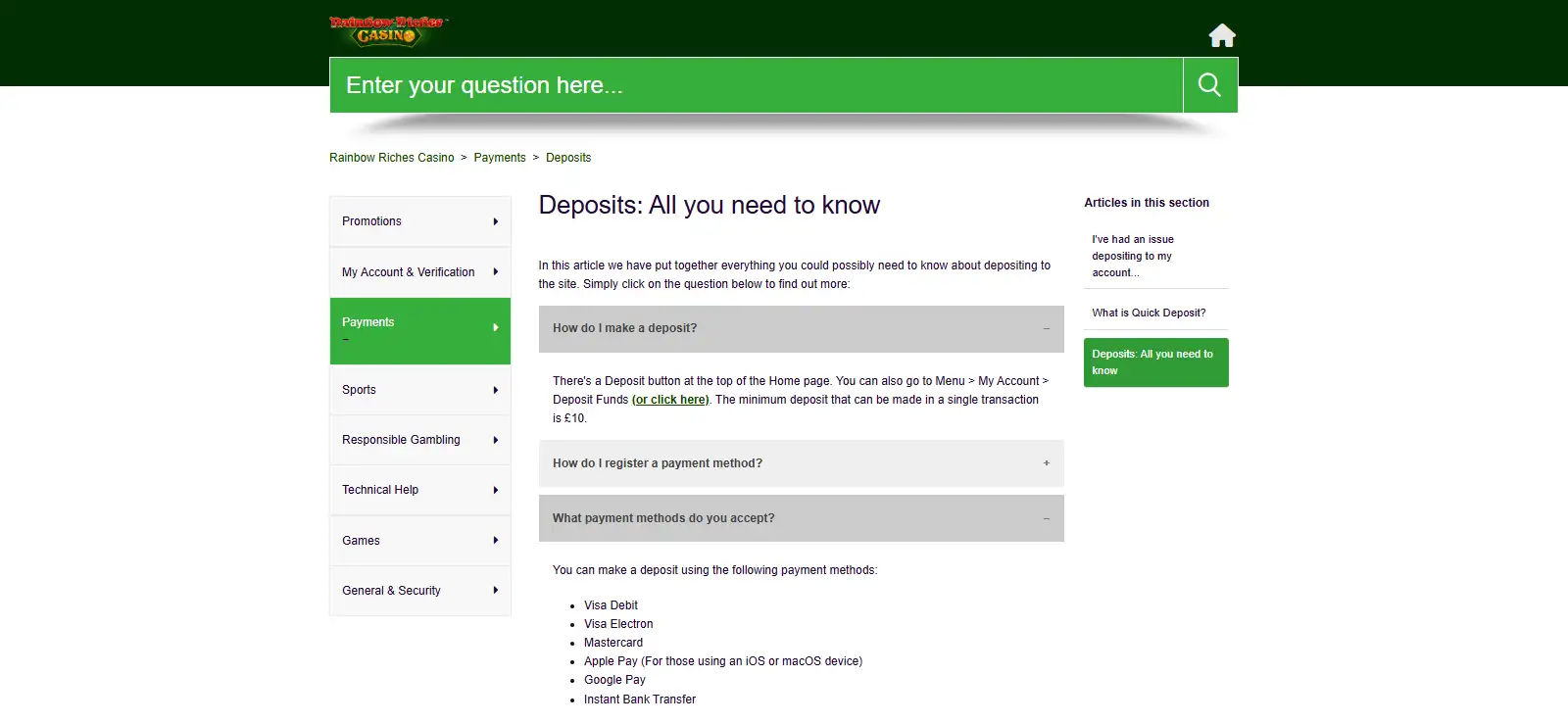
A specialist casino review gives a broad minimum-deposit range of £10–£20, with the amount depending on the payment method. Treat that as an indication from a review, not a universal rule for UK casino accounts. The figure that matters is the one shown to you in the cashier for your account and chosen route. It can differ between methods, and a casino may present different conditions to customers depending on account status.
The minimum is only one part of the cashier’s rules. A payment method may also have a maximum for a single transaction, while the casino may apply separate daily or monthly ceilings. Those limits can vary with the method and the customer’s account status. In practice, that means a route that allows a small deposit may not permit a larger one in a single transaction, and a transaction ceiling does not necessarily reveal the total amount you can deposit over a longer period.
| What to check | Why it matters |
|---|---|
| Minimum for the selected route | Determines whether your intended deposit can be accepted |
| Maximum per transaction | Sets the largest single deposit allowed through that route |
| Daily or monthly maximum | May restrict cumulative deposits over the relevant period |
| Account-level financial limit | Helps you control deposits across your account |
Read the cashier’s wording carefully: a transaction limit and an account-level financial limit are not interchangeable. The first is a condition of making a payment. The second is a control you set for yourself at account level. If you are comparing routes, note both rather than treating the highest permitted payment as a target.
UKGC rules require remote gambling operators to prompt new customers to set a financial limit before their first deposit. They must also make account-level limit controls accessible. This is a required part of opening and managing a gambling account, not an optional feature to look for only after you have deposited. Set a limit that reflects what you can afford to lose, and use the available controls to keep your spending within it.
A cashier’s deposit ceiling and your own financial limit serve different purposes. The operator’s ceiling is a boundary on what its systems will accept under particular conditions. Your limit is a personal spending control. If your chosen limit is lower than the cashier’s maximum, the personal limit should guide your decisions. There is little value in focusing on the largest available transaction if your own budget is smaller.
UKGC rules require remote gambling operators to prompt new customers to set a financial limit before their first deposit.
Account status can also affect payment limits, so do not assume that a figure seen before signing in will remain the applicable one after you access your account. Check the terms presented for your own account, and revisit them if the cashier displays a different threshold. Where a limit is unclear, ask customer support to explain whether it applies to one payment, a period, or the account overall before you proceed.
For a practical comparison, make a short table for the routes you are considering. Record the minimum, the transaction maximum, any daily or monthly ceiling, and your own account limit. Then compare each route against the amount you had already budgeted, rather than increasing that amount to meet a cashier minimum or to use more of the permitted maximum. If none of the available thresholds fits your budget, do not deposit.
The same discipline applies when a payment route is unfamiliar. A label such as eCheck does not tell you what minimum or maximum will apply to your account. Those details belong to the cashier’s current terms and your account controls. Confirm the relevant figures there, but keep the decision anchored to your budget—not to the payment ceiling. Maximum is not a recommendation.
A clear comparison keeps the decision simple: the cashier sets what a route will accept, your account may be subject to additional limits, and the financial limit you choose is the control for your spending. Set that limit before the first deposit, then treat it as the boundary for your own plan.


Instant Deposits Do Not Guarantee Fast Payouts
A deposit confirmation tells you that money has reached your gambling balance. It does not tell you how quickly a later withdrawal will reach your bank account. These are separate parts of a payment journey, with different steps and timing. Treating them as one speed rating can make a method look quicker than it is.
A specialist payment-method review describes open banking and bank transfers as routes that can provide instant deposits and fast withdrawals at many sites. That is useful context, but it is not a promise about every casino or every transaction. “Can provide” matters: the timing you experience depends on the particular service and payment, rather than on the broad label alone.
A separate specialist payment review notes that a card deposit may be instant while a payout takes several business days. The contrast is straightforward: money moving into a casino balance and money being sent back are not mirror operations. A quick deposit is no reliable measure of how quickly you will receive a withdrawal.
Two directions, two clocks
When you deposit, the payment is moving from your chosen source into the casino account. A successful authorisation or transfer can make the balance available promptly. Withdrawing reverses the direction, but it is not simply the same transaction played backwards. The casino must handle the withdrawal, and the payment route must deliver the funds to you.
Fast Deposits
A fast entrance is not a fast exit; do not extend a deposit-speed claim to the withdrawal journey unless explicitly stated.
That distinction matters when comparing an eCheck-labelled option with another route. The word “instant” may describe the deposit experience, not the payout. Unless the casino’s own payment information explicitly states what timing applies to withdrawals, do not extend a deposit-speed claim to the return journey. A fast entrance is not a fast exit.
For an eCheck deposit in particular, the label alone does not establish how soon a later payout will arrive. Nor does an instant-deposit description tell you whether withdrawals use the same timing. The useful comparison is not simply “instant” against “slow”; it is deposit timing and withdrawal timing considered separately.
What “fast” needs to mean
A comparison is clearer when you record two separate answers for each route:
| Timing question | What to establish |
|---|---|
| Deposit | When is the money available in the casino balance? |
| Withdrawal | How long may it take for the funds to reach you? |
If a payment description gives only a deposit estimate, the withdrawal column remains unanswered. Do not fill it in by assumption. If it describes both directions, keep the two statements separate and note whether the wording applies to a particular payment route or to the casino more generally.
The same discipline applies to open banking and bank transfers. A specialist review’s description of possible instant deposits and fast withdrawals is not a guarantee that every transfer will be instant in both directions. The word “fast” also does not mean the same thing as “instant”. Keep the wording the provider uses, and avoid turning a broad description into a firm arrival time.
Compare the wait you actually care about
If you are choosing a route mainly to get money into your balance quickly, deposit speed may be the deciding measure. If access to withdrawn funds matters more, compare payout timing instead. The stronger option depends on your priority; a single overall speed label conceals that trade-off.
Before relying on a timing claim, check whether it refers to a deposit, a withdrawal, or both. A deposit may appear promptly while a payout takes longer, and a route described as quick in both directions still does not make every transaction identical. Keep the two clocks separate. That is the useful comparison.

Keep the Payment Route in Your Own Name
Once you have chosen a payment route, keep the ownership details consistent. The casino account and the account or service used to pay should belong to you, under the same customer identity. That simple match can reduce avoidable questions about who sent the funds.
This matters whether you are considering an eCheck or another payment route. A method being available does not make every account suitable for using it. Before sending money, check that the payment account is yours and that the name and other account details correspond to the details held by the casino. A difference can prompt the operator to pause and establish who controls the payment.
The same principle applies when you request a withdrawal. A casino may need to confirm that the person receiving funds is the customer who made the deposit. Using one named account consistently for both sides of the transaction is often the cleanest arrangement. It gives the operator fewer basic ownership details to reconcile.
Matching your casino identity to your own payment account avoids creating a basic discrepancy that could otherwise need explanation.
Keep the information accurate rather than trying to work around a mismatch. If you have changed your name or your account details have changed, update the relevant records or ask the operator what it needs before making a payment. Do not assume that a payment from a relative’s account, a shared account or a service registered to someone else will be treated as yours. The operator may need to check the circumstances, and the transaction can take longer while it does so.
Consistency is not a promise that no checks will take place. Remote gambling licensees may still need to carry out KYC, and an operator can ask for information to establish ownership. The point is narrower: matching your casino identity to your own payment account avoids creating a basic discrepancy that could otherwise need explanation.
A useful check is to compare the name on your casino account with the name attached to the payment route before you use it. If those details do not match, resolve the issue first. One customer, one named account, used consistently: less avoidable friction.

Compare Payment Costs for the Amount You Will Send
A payment route with no visible fee is not automatically the cheapest. Compare the total cost for the amount you intend to send, rather than judging by a fee label or by another player’s transaction. The result can change with the amount, the providers involved and the currency used.
Build the comparison from the same starting figure for each route:
| Cost to check | What to compare |
|---|---|
| Casino charge | Whether the cashier or payment terms add a fee to the transaction |
| Payment-provider charge | Any fee applied by the service handling the payment |
| Bank or issuer charge | Whether your bank or card issuer charges for this type of transaction |
| Currency conversion | The exchange rate applied and any spread between that rate and a reference rate |
| Network cost | Any charge associated with processing the payment through a relevant network |
A specialist payment review identifies these as possible parts of a payment’s cost; they do not necessarily apply to every route. Check the terms for your casino, provider and bank rather than assuming that one party covers everything.
Use the intended transaction amount when comparing quotes. A flat charge has a different effect on a smaller payment than on a larger one, while a percentage-based charge changes with the amount. Conversion can also alter the final cost: a route that advertises no separate fee may still apply an exchange-rate spread. That spread can exceed a visible flat charge, so compare the amount that would actually leave your account with the amount credited to the casino.
For a fair comparison, record the amount sent, the currency taken from your account, each stated charge and the resulting amount credited. If the casino account and payment are in different currencies, include conversion in the calculation rather than treating it as an afterthought. A GBP balance can avoid conversion only when the account and payment are both handled in GBP.
Comparing Payment Costs
Use the same intended transaction amount for every route you are comparing.
Record the casino charge, payment-provider fee, bank issuer charge, and network costs.
Include the exchange rate spread if the casino account and payment are in different currencies.
Compare the actual amount leaving your account against the amount credited to the casino.
There is no universal lowest-cost method. The winner depends on the amount and the charges applied by the casino, provider, bank or issuer, and payment network. Check those figures for the transaction you plan to make; a general label such as “free” does not settle the comparison.
Check Payment Compatibility Before Using a Casino App
A payment method shown on a casino’s website is not proof that the same option will appear or work in its app. The app may present a different cashier, and the route you use can affect which payment choices are available. Check inside the app before relying on a method you saw on the website.
This matters when you are looking for an electronic cheque option. A general payment label or a page describing the casino’s cashier does not confirm that an eCheck can be used through the app. Look for the specific option in the app’s deposit screen and read any conditions shown there. If it is absent, do not assume that a similarly named bank or card option is equivalent.

The same check applies to cards. Specialist reviews may list Visa or Mastercard, but that does not establish current UK availability or confirm that your particular card product is eligible. The app cashier is the relevant place to check. UK-licensed casinos cannot accept credit-card payments for gambling, so a card logo alone is not enough to identify a usable debit-card route. Check what the cashier accepts and whether your card type qualifies.
A practical comparison is to check the casino website and app separately, then record the method displayed in each and any eligibility notes. If you plan to deposit in the app, confirm the method there rather than treating the website’s list as a guarantee. If you plan to use the website instead, check that route directly. Compatibility belongs to the route you intend to use.
Also distinguish seeing a payment name from being able to complete a transaction. A method might be listed in general information yet not be offered to your account or in the app’s cashier. Follow the app’s own instructions and stop if the available option does not match the route you intended. No guesswork needed.
For a casino described as accepting eChecks, the useful question is not only whether the brand appears somewhere on its site. Check whether the eCheck option is actually presented in the app’s cashier for your account. That is the difference between a general claim and a route you can verify.
Confirm the Details Before You Make a Deposit
Before sending money to a casino, check the payment option shown for your own account. A method mentioned on a general payment page—or in material about eCheck casinos in the UK—does not confirm that it is available to you at the point of deposit. Sign in, open the cashier and check the options displayed there. If the route you intended to use is absent, do not assume that a similarly named option will work instead.
Operator payment pages may list Visa and Mastercard, but that does not establish current availability in the UK or eligibility for every card product. The cashier is the practical checkpoint: confirm that your specific card or payment route is presented as an option before entering its details.
Confirm Deposit Details
- Sign in and open the casino cashier
- Verify the intended payment route is presented as an option
- Confirm the account currency is set to GBP
- Clarify any unclear details with the support team
Check the account currency separately. Operator pages may state that GBP is supported, but that alone does not tell you which currency your own account is set to use. Confirm the currency in the account or cashier before your first transaction. If the account is set to another currency, a deposit may be converted rather than processed in pounds.
Keep the check narrow: is the intended method available to your account, and is the account currency correct? If either point is unclear, pause and ask the casino’s support team to confirm it before proceeding. This avoids relying on a broad payment-method label when the decision concerns your particular account.
A clear cashier entry and a confirmed GBP account are the useful signals here. Do not treat a payment logo on a page as confirmation that your deposit is ready to go.
Understand the Total Cost of a Casino Payment
The amount shown beside a deposit method is not necessarily the full cost. For an eCheck casino payment in the UK, check each point where money could be deducted: the casino, the payment provider, your bank or card issuer, currency conversion, and any payment-network charge. A route with no visible casino fee can still carry costs elsewhere.
Separate fixed charges from costs that change with the transaction. A flat fee is straightforward to identify, but a currency conversion spread is built into the exchange rate rather than presented as a separate charge. A specialist review notes that this spread can outweigh a visible fee; the practical effect depends on the rate applied and the amount converted. Quiet costs are still costs.
Network fees may also apply, depending on the payment route. Check whether the provider charges for sending or receiving funds, and whether your bank or issuer adds a separate charge. Do not assume that a payment method’s displayed fee covers every party involved.
To estimate the total, start with the amount you intend to move and add each applicable charge. For a transaction in a different currency from your casino account, compare the exchange rate offered with the rate used by your payment provider, including any stated conversion markup. This makes the spread visible in the calculation, even when it is not itemised.
The lowest-cost route depends on the transaction amount and the providers involved. A fixed charge may weigh more heavily on a smaller payment, while a conversion spread can matter more when currency is exchanged. There is no universal winner. Count the whole route, not just the first fee you can see.
Why Casino Withdrawals May Not Return by the Same Route
A casino withdrawal is not always a simple reversal of the deposit. UK anti-money laundering controls commonly require a payout to go back to the original payment source. This closed-loop approach helps operators check where funds came from and where they are being returned.
That matters if you are considering an eCheck casino withdrawal in the UK: do not assume that a deposit route will also be available for cashing out. The casino’s cashier and withdrawal rules determine which routes it supports, while its payment controls may direct funds back to the source used for the deposit. A different route may be considered, but it can involve extra checks before the casino releases the money.
The route is only one part of the timing. First, the casino must review and approve the withdrawal. A specialist review notes that processing can take longer on a first withdrawal while verification is completed. After approval, the payment provider still has to deliver the funds. These are separate stages, so a delay at the casino is not the same as a delay in the banking or payment network.
Check the withdrawal terms for the route you used, and make sure any requested KYC documents are complete. If the cashier offers an alternative, ask whether it requires further verification and whether the casino has approved the payment before treating it as in transit.
Approval first. Delivery second.
Why can a fast payout casino still delay my withdrawal?
Your withdrawal still needs the casino’s internal approval, and a first payout may take longer while your account is verified.
Why must withdrawals return to the deposit method?
Returning funds to the original payment source is a common anti-fraud and anti-money-laundering control. Using a different route may require extra verification.
What is the current minimum deposit?
The minimum deposit usually starts at £10–£20, depending on the payment method.
Are Visa and Mastercard deposits definitely debit cards?
UK casinos commonly accept Visa and Mastercard debit cards, but check the cashier and your card product’s eligibility. UK-licensed casinos cannot accept credit-card payments for gambling.
Which method has the lowest fees?
There is no universal lowest-fee method. Compare casino and provider charges, bank or issuer fees, currency-conversion costs and any network fees for your payment.
Are fast casino withdrawals guaranteed?
No. Withdrawal speed depends on the casino’s approval process and whether your account is fully verified.
What is the fastest withdrawal method for UK casinos?
PayPal, open banking and debit cards linked to fast payout systems are generally among the quickest options, but processing still depends on casino approval and account verification.
Do UK casino withdrawals require verification?
Verification can be required, particularly for a first withdrawal, and completing it can help avoid delays.
Created by the ”Rainbow Riches Casino 1” editorial team.